The Major Arcana in Three Stages
The twenty-two Major Arcana are one story, the Fool's Journey, told in three movements: Initiation, Testing, Reckoning. What each stage means, and why the one your card sits in changes how it reads.
The twenty-two Major Arcana aren't twenty-two separate ideas. They're one story told in order, the Fool's Journey, and like most stories it moves in three movements. First you become someone. Then that someone gets tested by everything you can't control. Then you come out the far side and reckon with what the whole thing was. Initiation, Testing, Reckoning. The Almanac uses these three bands to place any card you're handed, so it helps to know what they are.
The cards fall into them cleanly, eight and then seven and seven, in the exact order they're numbered. Those rows go by different names in different hands. One common telling calls them the outer world, the inner world, and the spiritual world, and the stages here run along the same seam: you build a place among other people, you turn inward and get tried there, then you reckon with the largest things. Here's each stage, and why the one your card sits in changes how it reads.
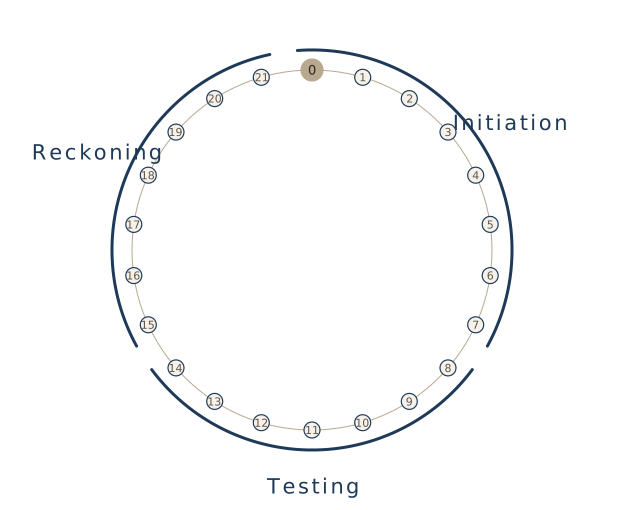
Initiation: cards 0–7
The Fool (0), the Magician (1), the High Priestess (2), the Empress (3), the Emperor (4), the Hierophant (5), the Lovers (6), and the Chariot (7).
This is the stretch where a person gets assembled. The Fool starts with nothing, one bag and a drop off a cliff he can't see the bottom of. Everything after is picking up equipment. The Magician finds out he has hands and a table of tools. The High Priestess is the quieter knowing underneath the tools, the sense of a thing before you can say it. Then come the two big shapes every kid grows up inside: the Empress, who is warmth and abundance and the body that feeds you, and the Emperor, who is the rule and the wall and the word that ends the argument. The Hierophant is what they hand you on purpose, the tradition, the church, the way it's done around here. The Lovers is the first choice that's actually yours, the moment you stand at a fork nobody else can walk for you. And the Chariot at 7 is you taking the whole assembled kit out the front door and putting it in motion.
Initiation cards read as beginnings, but not soft ones. This is the equipment being gathered, before life has really leaned on any of it. A Magician day is a day you have what you need and haven't been worn down yet. There's a freshness to this band, and a naivety too, because none of it has been tested. That comes next.
Testing: cards 8–14
Strength (8), the Hermit (9), the Wheel of Fortune (10), Justice (11), the Hanged One (12), Death (13), and Temperance (14).
Now the equipment gets used, and worn, and sometimes broken. Strength opens the middle for a reason: the lion is already there, and the card is you keeping your hand on its jaw without a fight, day after day, which is harder than any single dramatic act of courage. The Hermit takes the lamp and goes off alone, because some of what tests you can only be met in the quiet with nobody watching. Then the Wheel turns and hands you luck you did nothing to earn and can't refuse. Justice weighs what you actually did and returns the consequence, cleanly, without mercy or cruelty. The Hanged One is the season of being stuck on purpose, hung upside down, waiting, seeing the room from an angle you'd never have chosen. Death is the ending you don't get a vote on. Temperance closes the band by taking all of it, the loss and the luck and the waiting, and slowly cooking it back into something you can live with.
These are the middle cards, and they carry the most weight in a reading because this is where a life is decided. A card sitting in the Testing third is asking what you're made of. It's the pressure that either sets the equipment or shows you which piece was never real. When the Almanac tells you a day's card sits here, it's telling you the day has some grit in it, whatever the specific card.
Reckoning: cards 15–21
The Devil (15), the Tower (16), the Star (17), the Moon (18), the Sun (19), Judgement (20), and the World (21).
The last band is the accounting. The Devil starts it by showing you the chain around your ankle and then showing you it isn't locked, that you've been holding the loose end this whole time. The Tower is the lie collapsing all at once, the structure you built on bad ground coming down in an afternoon, and the relief on the other side of the wreckage. The Star is the long exhale after, water poured out under a clear sky, hope that's finally quiet enough to trust. The Moon is the last stretch of fog, the walk home in the dark when you can't tell the road from the ditch and go anyway. The Sun is plain daylight, nothing hidden, the warmth you stopped expecting. Judgement calls the whole life up for review and asks you to answer for it honestly. And the World at 21 is the thing complete, the circle closed, standing where the Fool once stepped off with no idea any of this was coming.
Reckoning cards read as arrival and reckoning at once. They're where things resolve, but resolution here means facing the account, not a tidy ending. A card in this last third carries the sense of something coming due, or coming clear. And then the World rolls back to the Fool at 0, because the account closing is also the next thing beginning, and the wheel just keeps turning.
Why the stage matters in a reading
The Almanac already knows which band every card belongs to, and it uses that. When it turns a date into a Major, it also places that Major in its third, so a Death day reads differently from a Death card pulled cold, because you can see it sitting in the Testing stretch where the hard middle of things happens. The natal chart uses the same three bands to place the cards you were born under. A Bearing in the Reckoning third has a different weather to it than one down in Initiation.
None of this is a verdict on your day. The band is orientation, a way of knowing roughly where on the arc you're standing, the same way knowing it's late autumn tells you something real without telling you what tomorrow holds. A Testing card doesn't promise a hard day. It tells you the card you're under belongs to the part of the story where things get tried, and you take that for what it's worth. The math gives you the card. The stage tells you where in the journey it lives. What you do standing there is yours.
If you want the arithmetic underneath all of it, How Tarot Numerology Works lays out how a date becomes a card. Or you can walk the deck in order and watch the three movements pass, one to the next, the Fool at the start of it all.
See which stage today's card falls in. Open The Tarot Almanac →