What Is Your Tarot Birth Card?
The card your birthday hands you for life. How the standard Personality and Soul card calculation works, and why the Almanac reads your birthday a different way.
Somewhere along the way you typed your birthday into a calculator and it handed you a tarot card. Maybe two. It told you that card was yours for life, the one the Major Arcana had been holding for you since the day you were born. That's a tarot birth card, and the instinct behind it is right: your birthday is a fixed thing, so the card it points to should be fixed too. No shuffle, no draw, the same answer every time you ask.
Which card you get, though, depends entirely on the arithmetic.
How the standard birth card is calculated
The common method has been around for over a century. You take your whole birthdate, month and day and year, and add it together. Then you reduce: if the total sits above twenty-two, you add its digits and keep going until you land on a number the Major Arcana can hold.
Say you were born on June 11, 1992. Add the pieces: 6 plus 11 plus 1992 is 2009. That's a long way past the end of a twenty-two card deck, so you reduce it, 2 plus 0 plus 0 plus 9, and get 11. Card eleven is Justice. That's your first birth card, the one usually called the Personality card.
Most people get a second one. You take that Personality number and reduce it again, down to a single digit. Eleven becomes 1 plus 1, which is 2, the High Priestess. That's the Soul card. So June 11, 1992 comes out as Justice and the High Priestess, the personality you meet the world with and the soul sitting under it.
If your first number is already a single digit, the two cards are the same and you carry just one. And there's one result that gives three: any birthday whose total reduces to nineteen unfolds into the Sun, the Wheel of Fortune, and the Magician, because nineteen reduces to ten and ten reduces to one, and the tradition keeps all three.
What the reduction does to the deck
Look again at the second step, the one that makes the Soul card. It reduces your number to a single digit, one through nine. So your Soul card can only ever be one of the first nine: the Magician, the High Priestess, the Empress, the Emperor, the Hierophant, the Lovers, the Chariot, Strength, the Hermit. Everything from the Wheel of Fortune onward, the whole back half of the deck, is out of reach before you start. The Tower can't be your Soul card. Neither can the Star, the Moon, or the World. They get reduced away.
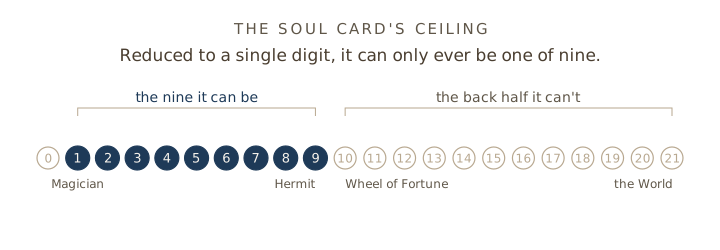
This is what reduction does everywhere, and it's why reduction can only reach half the deck. It pushes every number toward the small end, and the cards with the largest numbers, the ones the Fool's Journey spends the whole deck building toward, fall out of range. The birthday method inherits the problem whole. It rounds a world of people off toward a short list of types, which is why birth cards can start to feel like sun signs: everyone slots into one of a handful.
There's a second thing hiding in the sum. Your birth year is in there, and at three or four digits it's the largest number in the addition, so it does most of the sorting. Two people born the same day in different years get pulled onto different cards by a year that has nothing to do with either of them. A sister born June 11, 1969 runs 6 plus 11 plus 1969, which comes around to 6, the Lovers. Same day as our 1992 birthday, a whole different card, and the only thing that moved was the year.
The card the Almanac reads instead
The Almanac keeps the good instinct, your birthday pointing to one lifelong card, and changes the arithmetic. Instead of reducing, it uses the wheel of twenty-two: the Major Arcana laid out as a circle, zero through twenty-one and around again, so a date lands on a position rather than collapsing to a single digit. And instead of your whole birthdate, it uses only the month and the day.
Add your birth month and birth day, wrap around the wheel if you pass the end. June 11 is 6 plus 11, which is 17, the Star. That's your Bearing, and it's the card June 11 carries in every year there is. Not Justice, not the High Priestess. The Star. Those two sisters born June 11, one in 1992 and one in 1969, share it: same birthday, same Bearing, the card the calculators split them apart on.
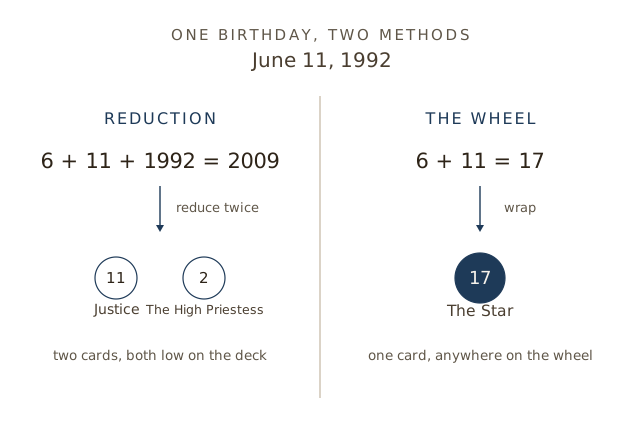
Two things moved to get there. The year came out, and the reduction became a wrap. The year comes out because a Bearing measures a distance, the fixed gap between your card and the world's card on any given day, and when you measure that gap the year sits on both sides and cancels, leaving your birthday standing there by itself. The reduction becomes a wrap because a wheel doesn't need to shrink a big number, it just carries it around, so the whole deck comes back into play. Every one of the twenty-two can be a Bearing. The Star, the Tower, and the World stand right alongside the Magician, and nobody gets stranded in the first nine.
Your birth year isn't thrown out, for what it's worth. It's just not what a Bearing is made of. The year lives in your natal chart, the fuller reading that runs your exact birthdate, year and all, through the daily engine. The Bearing is the one piece of that chart that holds still your entire life, which is why your birthday alone is enough to find it.
So which one is your birth card
Both are, depending on what you're asking. The Personality and Soul cards ask what kind of person you are and answer from a short list of types. The Bearing asks where you stand in relation to the world and answers with any card on the wheel. One is a portrait. The other is an angle.
If you've run the calculators before and wondered why they kept handing you and half your friends the same few cards, that's the reason: the arithmetic was rounding everyone toward the same small corner of the deck. Add your month and day, wrap the wheel, and see which of the full twenty-two your birthday actually points to.