The 2027 Universal Year Number and Its Tarot Card
Every year has a number everyone shares, and 2027's is eleven. Numerology names eleven a master number and then reads it as a two. The wheel of twenty-two keeps it at eleven, which is where Justice sits, and those are two very different years.
The digits of the year 2027 add up to eleven. That eleven is the universal year number, the figure everyone shares before any birthday is taken into account.
For most of this decade the sum has been small enough that nothing had to be done with it. The digits of 2024 come to eight, and eight is where they stop. Eleven does not stop. It's larger than the system that has to carry it, and the way that gets resolved is the reason you'll see two different cards named for 2027 this winter.
The rule that makes numbers smaller
Numerology works with nine numbers. When a sum runs past nine, its digits are added together again, and again if necessary, until one digit is left. Ten becomes one. Twelve becomes three. The rule is old, it's applied consistently, and it's what allows a reading to say something definite about any date at all.
The rule also has an exception, and the exception is nearly as old. Two totals, eleven and twenty-two, are held to be master numbers: too significant to reduce, and left standing. Practitioners differ on how far that exemption reaches, and most published readings settle it the same way. They keep the eleven in the title and read the two in the body.
The 2027 forecasts already in circulation show the compromise clearly. The year is given as Universal Year 2 with an eleven undertone. The eleven is credited with heightened intuition and awakening. The twelve months themselves are then described as a period of partnership, patience, and slow cooperative work, which is a description of a two. One forecast states the arrangement outright, saying the eleven operates on the chassis of the two.
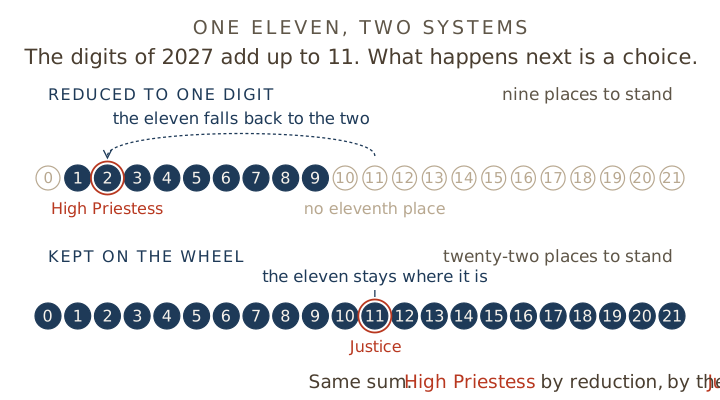
The two comes back because there's nowhere else to put it. A system with nine places has no eleventh place, and the number has to stand somewhere.
The other way to hold an eleven
The Tarot Almanac wraps its totals instead of reducing them. The twenty-two Major Arcana are laid in a circle, numbered zero through twenty-one, and any total that runs past the end continues around from the beginning. Twenty-two comes back to zero, the Fool. Twenty-nine comes back to seven, the Chariot.
Eleven never reaches the end of the circle, so nothing is done to it at all. It stays eleven, and the eleventh card is Justice.
The same sum, reduced, is a two. The second card is the High Priestess.
Six years of agreement, then four of drift
The disagreement is recent and it's temporary, which is much of why it goes unremarked.
| Year | Digits add to | Reduced | On the wheel |
|---|---|---|---|
| 2020 | 4 | 4 | The Emperor |
| 2021 | 5 | 5 | The Hierophant |
| 2022 | 6 | 6 | The Lovers |
| 2023 | 7 | 7 | The Chariot |
| 2024 | 8 | 8 | Strength |
| 2025 | 9 | 9 | The Hermit |
| 2026 | 10 | 1 | The Wheel of Fortune |
| 2027 | 11 | 2 | Justice |
| 2028 | 12 | 3 | The Hanged One |
| 2029 | 13 | 4 | Death |
| 2030 | 5 | 5 | The Hierophant |
From 2020 through 2025 the digits of the year came to nine or less. There was nothing to reduce, both methods returned the same number, and the question never arose. Six years, one answer each, running from the Emperor to the Hermit.
In 2026 the sum reached ten and the methods parted for the first time in the decade. Reduction returned a one. The circle returned card ten, the Wheel of Fortune, which is the card of the turn itself. In 2027 the sum is eleven, and the answers are a two and Justice. In 2028, a three and the Hanged One. In 2029, a four and Death. Then in 2030 the digits fall back under ten, both methods say five, and the disagreement closes as quietly as it opened.
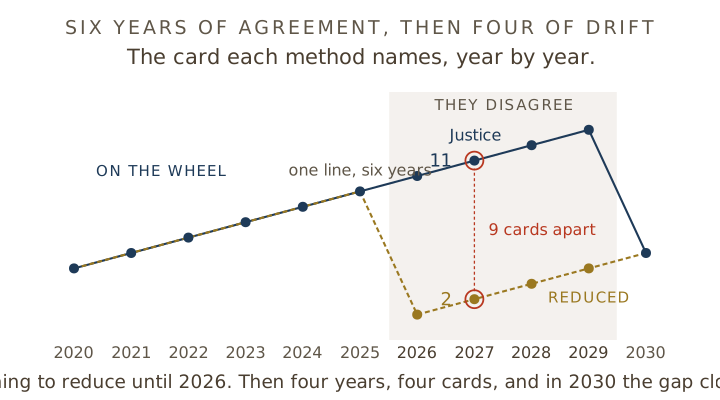
Four years, four cards. Between 1900 and 2100, 164 of the 201 years have digits adding to more than nine, so the agreement of the early 2020s is the unusual stretch and not the ordinary state of things.
What each of the two cards asks
Justice is the part of you that wants the truth even when it costs something. At the scale of a year it turns outward, and asks a collective to look honestly at what's been built, what it cost, and who paid. Things that were papered over become harder to paper over.
The High Priestess is the knowing that arrives before the reasons do. A year under her is quiet and turned inward. It rewards depth over display, and asks you to trust what you sense before you can prove it, and to let a thing form below the surface before anyone gives it a name.
Consider what it would mean to prepare for the wrong one. A person who reads that 2027 is a year of patience and partnership will keep their counsel and wait for the room to come around, which is sound advice for a High Priestess year and a full twelve months of waiting through a reckoning. Neither card is the better one to receive. They ask for opposite things in the same year.
Both cards also reverse twice, and the second reversal is where they reach the reader most directly. The High Priestess refuses to make everything legible. The world rewards people who explain themselves, and she's the one who declines, who keeps an inner life that belongs to no one else. Justice refuses to confuse the law with what's right. If you were judged before you were known, if the systems meant to be fair failed you, Justice names that as real rather than imagined. One year gives you permission to keep a room closed. The other gives you your own account of what happened.
Your own 2027
The universal year is half of the calculation. The other half is your birthday, and this is where reduction costs the most.
Say you were born on March 15. Numerology adds your three and your fifteen to the year's eleven and folds the total down to a two. That's the same digit the world was given, which happens to about one birthday in nine. Your own year and the collective year land on the same rung, and you spend 2027 reading everybody's forecast.
The Almanac keeps the sum whole. Three plus fifteen is eighteen, and eighteen is your Bearing, the Moon, the card that birthday carries in every year there is. Add the year's eleven and the total is twenty-nine, which comes around the circle to seven. The Chariot. Not the world's card, and not a two.
Eleven has one further property. It's exactly half of twenty-two, so in 2027 every person alive stands directly across the circle from their own Bearing, at the greatest distance the wheel allows. The 2027 tarot year card covers that year at length, Justice and all twelve of its months, and your personal year number has the general case.
What the rule costs
Numerology has read master numbers for a long time, and Universal Year 2 is a workable description of a year. Slower, more cooperative, less push. Held against your own life it may well fit, and if it fits, keep it.
What reduction spends is the position. Eleven and two are different places to stand, and the arithmetic of the year only ever pointed at one of them. It's the same trade the rule makes on a birthday, which is why reduction can only reach half the deck: the number gets made smaller so it'll fit a system with nine rooms in it.
If you were promised a year of patience and partnership, and 2027 arrives asking questions you'd rather not answer, this is where the difference went.