Your Life Path Number and Your Tarot Card
The number numerology folds your whole birthday down to, and the tarot card it points to. Why a single digit reaches only the first nine Majors, and how the Almanac reads your birthday instead.
You might already know your life path number. It's the one numerology hands almost everyone first: add up every digit of your birthday, keep folding until a single digit is left, and that number is supposed to describe the shape of your whole life. Born on March 3, 1990? Add the three, the three, and the one, nine, nine, zero, keep going, and you land on seven. Seven is your life path.
Tarot borrows it directly. Take that single digit and match it to the Major Arcana card wearing the same number. Seven is the Chariot. So a life path seven "is" the Chariot, the card of the person who keeps moving through opposing pulls and holds the reins anyway. It's a clean, satisfying trick, and a good half of the tarot internet runs on it.
The trick has a ceiling, though, and once you notice it it's hard to miss.
The mapping, and where it stops
Here's the whole conversion. One is the Magician. Two, the High Priestess. Three the Empress, four the Emperor, five the Hierophant, six the Lovers, seven the Chariot, eight Strength, nine the Hermit. That's the list: nine numbers, nine cards, the first nine steps of the deck.
Everything past the Hermit is unreachable. The Wheel of Fortune is card ten, and a single digit never reaches ten. Death is thirteen. The Tower is sixteen. The Star, the Moon, the Sun, and the World sit at seventeen through twenty-one, the far end of the Major Arcana, the cards the Fool's Journey spends twenty-one steps climbing toward. A life path number can't land on a single one of them. It reduced them out of range before you were out of bed.
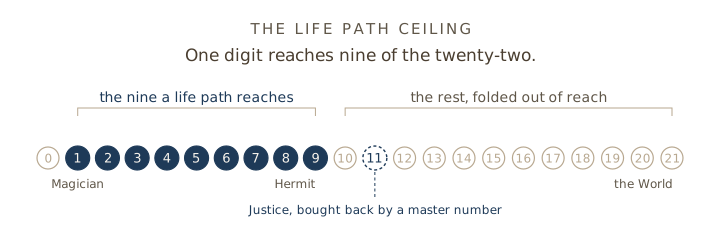
This is the same thing reduction does everywhere, and it's why reduction can only reach half the deck: folding a number down to one digit pushes it toward the small end and strands the tall cards. Your tarot birth card has a milder version of the same problem, because its deepest reduction, the Soul card, is that identical single-digit fold. The life path number just does it in one move and calls the answer your life.
The tell hiding in the master numbers
Numerology noticed. That's what the master numbers are for.
If your digits add to eleven, twenty-two, or thirty-three somewhere on the way down, the rule says stop, leave those alone. Someone born June 11, 1992 folds to eleven and keeps it: life path eleven, which lands on Justice, card eleven. Without the exception they'd reduce the one and the one to two and end up at the High Priestess, back in the first nine with everyone else.
Look at what that exception is doing. It exists to rescue numbers that reduction would otherwise flatten. Eleven buys back Justice. Twenty-two is stranger, because there's no card twenty-two: the Majors stop at twenty-one, so most readers send it home to the Fool at zero, the deck's other bookend. The master-number rule is numerology quietly conceding that reducing everything to one digit throws away something real, then patching two cards back in by hand. Even with the patch you reach eleven of the twenty-two. The other half still never arrives.
What the Almanac does with your birthday instead
A life path number is built to be one governing digit. That's the whole design in numerology: a single number you carry, a signature. Taken on those terms it's a fine idea. The strain only shows when you press it into tarot, because the deck has twenty-two doors and a single digit knocks on nine of them.
The Almanac keeps your birthday pointing to a lifelong card and drops the reducing. Instead of folding your date to a digit, it sets it on the wheel of twenty-two: the Major Arcana laid in a circle, zero through twenty-one and around again, so a birthday lands on a position rather than collapsing to a single number. And it adds only your month and your day, not the whole date.
March 3 is three plus three, which is six, the Lovers. That's your Bearing, the card March 3 carries in every year there is. A life path reading of that same birthday sends you to the Chariot; the wheel sends you to the Lovers, and the Lovers had to beat out all twenty-one other cards to get there. Some birthdays land on Death. Some on the Tower, some on the Star, some on the World. Nobody gets rounded down into the first nine, because nothing is being rounded.
Your birth year isn't lost in the trade. A life path number actually spends most of its arithmetic on the year, since a four-digit year is the biggest thing in the sum. The Bearing leaves the year out on purpose: it measures the gap between you and the world, and the year sits on both sides of that gap and cancels. The year still has a place. It lives in your natal chart, the fuller reading that runs your exact birthdate, year and all, where it carries a card of its own. The Bearing is only the piece of that chart that never moves.
So is your life path card wrong?
No. If life path seven and the Chariot feel like you, keep them. Reading a birthday by a single signature number is old and real, and plenty of people recognize themselves in it. But if you've ever noticed that you and most of your friends keep landing on the same short list of cards, the ceiling is the reason. One digit only reaches nine of them.
Add your month and your day, wrap the wheel, and see which of the full twenty-two your birthday actually points to.