The Card of the Day You Met
Every date has a card already, set before anyone picked it. How to find the one under your wedding day, the day you met, or any date you've come to care about, and why it changes every year you come back to it.
You picked a date, or you're picking one, and somewhere between the venue deposit and the seating chart you started wondering whether the date itself means anything.
It does, and you don't have to draw a card to find out. Your date already has one. So does the day you met, and so does every other day you'll end up caring about. You can work out any of them on paper in about a minute.
Work out one day and you've got the whole month
Three steps. Add the digits of the year, then add the month, then add the day.
Take the first of June 2027. Two and zero and two and seven come to eleven. Add the month, six, and you get seventeen. Add the day, one, and you get eighteen.
Then set eighteen on the wheel of twenty-two. The Major Arcana are numbered zero through twenty-one, and when a number runs past the end it comes back around, the way a clock does. Eighteen is short of the end, so it stays eighteen. Eighteen is the Moon, and 1 June 2027 is a Moon day.
Here's the part that saves you the arithmetic. Every day after that moves up exactly one card. The second is the Sun, the third is Judgement, the fourth is the World, and when you run off the end of the wheel you come back around to the Fool and keep going. A thirty-day month holds all twenty-two cards with a few to spare.
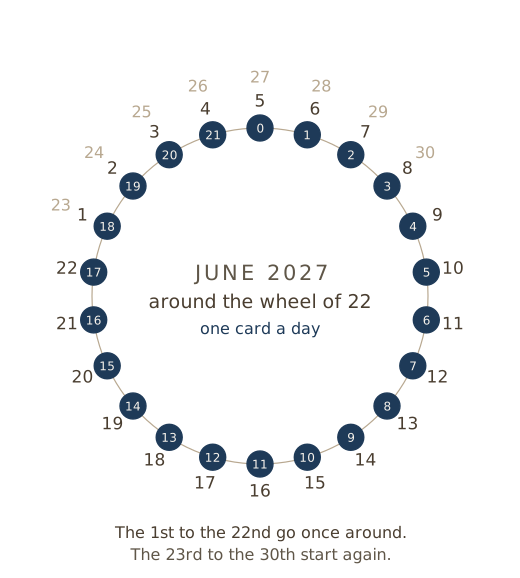
So if you're getting married in June 2027, your whole month looks like this:
| Day | Card | Day | Card |
|---|---|---|---|
| 1 | The Moon | 16 | Justice |
| 2 | The Sun | 17 | The Hanged One |
| 3 | Judgement | 18 | Death |
| 4 | The World | 19 | Temperance |
| 5 | The Fool | 20 | The Devil |
| 6 | The Magician | 21 | The Tower |
| 7 | The High Priestess | 22 | The Star |
| 8 | The Empress | 23 | The Moon |
| 9 | The Emperor | 24 | The Sun |
| 10 | The Hierophant | 25 | Judgement |
| 11 | The Lovers | 26 | The World |
| 12 | The Chariot | 27 | The Fool |
| 13 | Strength | 28 | The Magician |
| 14 | The Hermit | 29 | The High Priestess |
| 15 | Wheel of Fortune | 30 | The Empress |
If you're marrying in a different month, do the three steps once for the first of yours and then count down the days from there. It's the same wheel either way.
Your card might not look like a wedding
Look at that list and you'll see the problem straight away. The eleventh is the Lovers, which is the one everyone wants. Then there's Death on the eighteenth and the Tower on the twenty-first, and if you booked one of those you're probably not thrilled to hear it.
Take them one at a time.
Death is not about anyone dying. In the Almanac's reading, Death "is the part of you that lets something end so something else can begin. It is release, transformation, the clean cut that makes room. Its endings are transitions, not punishments." A wedding ends two single lives on purpose. That's the whole event.
The Tower is the harder one to sell, and I'm not going to pretend otherwise. It's "the collapse you saw coming, dreaded, and underneath maybe needed," the false thing coming down so something true can stand where it stood. Some couples will read that and know exactly what it's pointing at.
The Hermit on the fourteenth looks wrong for a wedding too, until you read it. He's "the clarity that only comes once you get quiet," the walk alone where the thing you couldn't untangle in a loud room comes clear. Think about the year before a wedding, with everyone's opinion about the dress and the guest list. Getting quiet enough to hear your own answer is most of the work.
None of these cards is a warning. A hard card here is a hard thing named honestly.
The shape and the texture
There's a second card on each day, and it's worth knowing which way round the two sit.
The Major is the shape underneath, the archetype the day belongs to. On top of it sits a Minor Arcana card, the texture, the grain of how that shape actually shows up. The texture is drawn from the shape rather than chosen, so the suit follows the Major's element. The fourteenth is the Hermit, which is an earth card, so its texture is a Pentacle, and specifically the Ace of Pentacles.
The thirteenth is worth a look for a different reason. Its shape is Strength and its texture is the Four of Wands, which is the card most tarot readers already treat as the wedding card, the one they associate with celebrations and coming home. Nobody put it there on purpose.
Minors belong to days. A year doesn't get one, and neither does a month.
Is it a good date?
The wedding numerology you'll find online is built to answer that, and it answers with confidence. It works by adding every digit in the date and then adding the result again, over and over, until one digit is left. The fourteenth becomes a five, because it adds the one and the four. That's the difference between the two methods, and it's why they rarely agree.
The Knot runs a version of this. So do the numerology sites the wedding blogs borrow from, and people have been picking dates this way for decades. The same fold sits under every birth-card calculator, where it costs the same thing, which is why reduction can only reach half the deck.
They don't agree with each other, though. One site will tell you nine is the number of endings and steer you off it. The next will tell you dates adding to nine are fortuitous. Six and eight show up as lucky nearly everywhere, five and seven as risky on some lists and fine on others. There's no way to check any of it, because there's nothing underneath the assignment to check. Somebody decided six was the love number and the rest of the internet copied it.
Their answers also have a lot of company. In 2027, thirty-six days add up to twenty-two, which most of those sites call a master number and rank near the top. Thirteen days that year are the Hermit, and two of those carry the Ace of Pentacles.
So I'm not going to tell you your date is lucky. It isn't lucky or unlucky. It's specific, and specific is the thing you can use.
The dates you didn't choose
You pick a wedding date. Most of the dates that end up mattering, you don't.
Say the two of you met on 8 October 2011. That day's shape is the Fool, card zero, the willingness to step off into something before you can see where your foot will land. Good card for a first meeting.
Its texture is the Five of Swords, which is scrappier. Somebody won something and it cost them. That's a strange thing to find on the day two people met, and it isn't a judgment on either of you. It was set before you got there.
The day you moved in, the day the job came through, the day someone was born: they all have cards already. Some are lovely and some are hard, and the hard ones are often the days a couple points to when they say this is when things changed.
Every anniversary is a different card
The same calendar date gives you a different card each year you come back to it.
| Anniversary | Card |
|---|---|
| 2027, the wedding | The Hermit |
| 2028 | Wheel of Fortune |
| 2029 | Justice |
| 2030 | The Empress |
| 2031 | The Emperor |
| 2032 | The Hierophant |
| 2033 | The Lovers |
| 2034 | The Chariot |
| 2035 | Strength |
| 2036 | The Hermit |
The card you married under comes back on the ninth anniversary, then the eighteenth, then the twenty-seventh.
The fifth one is the Hierophant, which is the most wedding-shaped card there is: tradition, lineage, belonging to something older than yourself. A wedding is the most public borrowing of an old form that most people ever do. You say words other people wrote, because they were said before.
That card reverses two ways, and plenty of couples will know the second one first. One reversal is the tradition closing its fist. The other the Almanac calls the reclaiming, and it's holy refusal: "the break from the systems that tried to erase you, the decision to stop asking permission from an institution that was never going to give it." If the tradition you were handed had no room for you and you married anyway, in a form you put together yourself, that's the reclaiming Hierophant. Same card, fifth anniversary.
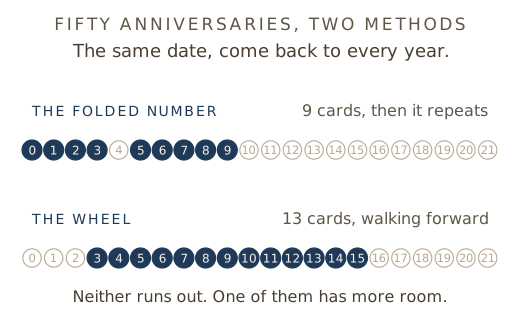
Over the first fifty anniversaries the folded number gives you nine different answers. The wheel gives you thirteen different cards.
If your date hasn't happened yet
The dated pages here cover the whole past and stop one month past the current one, so a wedding two years out doesn't have a page yet.
The arithmetic doesn't wait, and you've already got it. Year, then month, then day, then around the wheel. Do it on paper and check it against the page when the date comes close enough to open. It'll say the same thing.
The day you met is easier. That one's in the past, and the past is open.